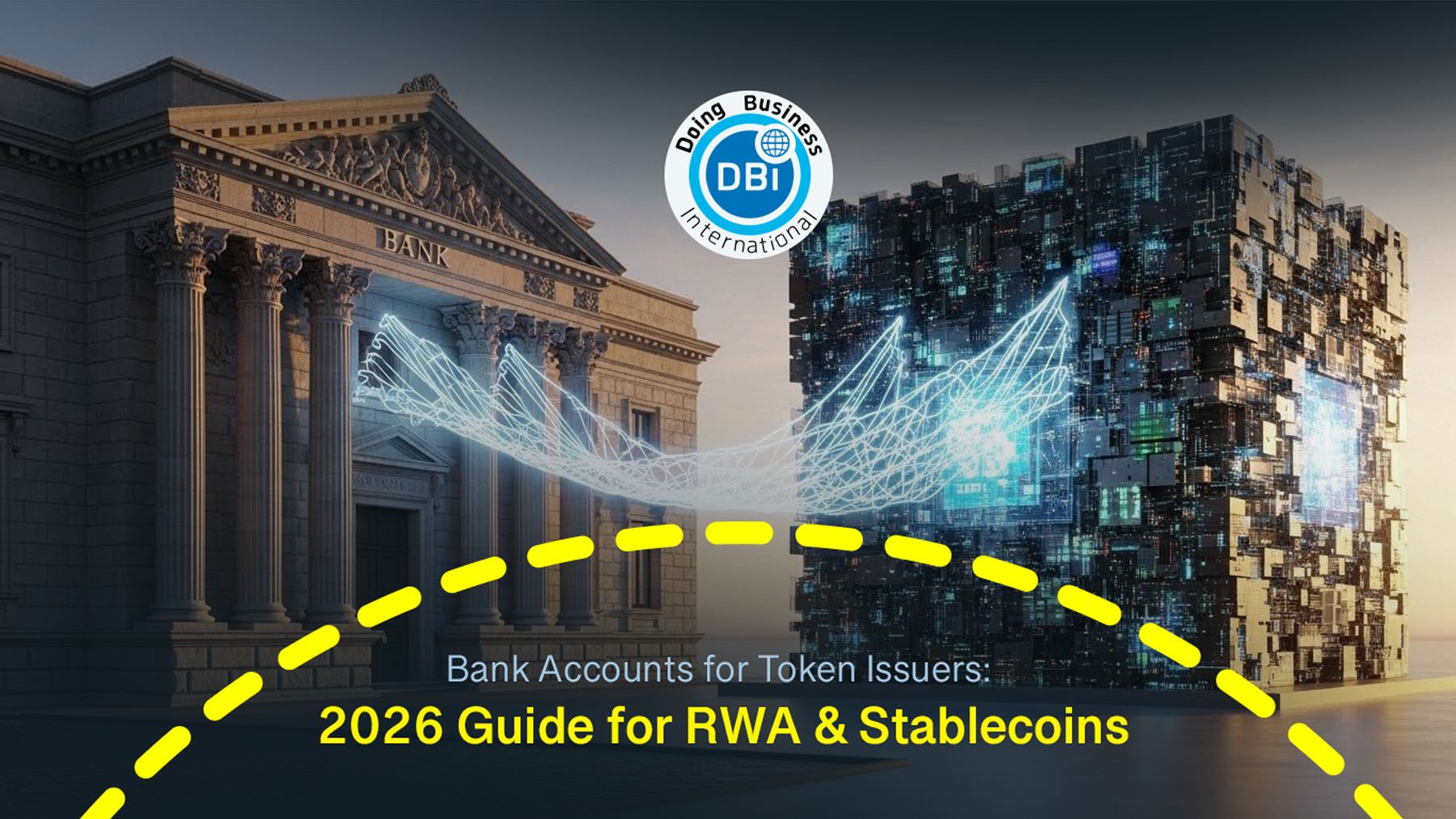
Banking for Token Issuers in 2026: Why RWA Is the New Gold Standard
By Doing Business International | January 9, 2026
Introduction: The End of the Wild West
If you are issuing tokens in 2026, your banking strategy determines whether your project survives or dies.
The era of unregulated ICOs (Initial Coin Offerings) is over. The “wild west” period of 2016, 2019; when projects raised millions with a whitepaper and a Telegram group, has been replaced by institutional-grade tokenization, regulatory scrutiny, and banking discipline.
Today, banks are no longer asking if they will onboard token issuers.
They are asking which ones deserve access.
And the answer is clear:
Real World Assets (RWA) are the new gold standard.
With institutions like BlackRock, Citi, JPMorgan, and Nasdaq settling transactions on-chain, the gates are open, but only for token issuers who fit a regulated, auditable, and compliant mold.
What Are RWAs? (Definition for SEO & AI Search)
RWA (Real World Assets) are physical or financial assets represented as blockchain-based tokens.
Examples include:
• Real estate
• Bonds and treasury bills
• Credit, invoices, and receivables
• Infrastructure and commodities
• Private equity and fund shares
Why RWAs Matter in 2026
According to aggregated industry research (BCG, McKinsey, World Economic Forum), tokenized RWAs are projected to exceed USD 10-16 trillion in value by 2030, with 2026-2027 identified as the institutional inflection point.
Banks now view RWA platforms not as “crypto startups,” but as:
• Digitized securities issuers
• Programmable asset managers
• Next-generation settlement infrastructure
Who Is Leading the RWA Race in 2026?
🇪🇺 European Union, Regulatory Leadership
The EU is currently the global leader in tokenization regulation, thanks to MiCA.
MiCA (Markets in Crypto-Assets Regulation):
• Fully applicable since 2024–2025
• Creates legal certainty for:
• Asset-referenced tokens
• Stablecoins
• Token issuers and service providers
Why banks love the EU:
MiCA gives compliance teams something they value most: clarity.
Countries leading within the EU:
• 🇩🇪 Germany (BaFin-licensed crypto custody banks)
• 🇫🇷 France (AMF-regulated token issuers)
• 🇱🇮 Liechtenstein (TVTG / Blockchain Act)
• 🇨🇭 Switzerland (FINMA-regulated DLT securities)
🇺🇸 United States - Institutional Scale, Slower Clarity
The U.S. remains the largest capital market, but regulatory fragmentation persists.
Key developments:
• OCC (Office of the Comptroller of the Currency) granting limited crypto custody permissions
• Proposed GENIUS Act and stablecoin frameworks
• Tokenization pilots by BlackRock (BUIDL) and Franklin Templeton
Reality in 2026:
Serious U.S. token issuers often:
• Incorporate or license abroad (EU, UAE)
• Use U.S. banking only for settlement layers
🇦🇪 UAE - Fastest-Moving Jurisdiction
The UAE has become the preferred hub for global token issuers.
Why?
• VARA (Dubai)
• ADGM (Abu Dhabi)
• Pro-tokenization banking infrastructure
• Clear RWA frameworks
By 2026, the UAE hosts dozens of regulated tokenization platforms, particularly in:
• Real estate
• Private credit
• Islamic Finance-Compliant RWAs
** MiCA stands for Markets in Crypto-Assets Regulation.
It is the European Union’s comprehensive legal framework for crypto-assets, designed to regulate how crypto assets are issued, offered, and serviced across all 27 EU member states.
MiCA is one of the most important regulations shaping tokenization, stablecoins, and Web3 banking globally.
Banking Reality in 2026: Two Buckets Only
Banks classify token companies into two categories:
1. Regulated Innovators
✅ Get accounts
✅ Access custody
✅ Receive settlement APIs
✅ Treated as institutional clients
2. Unregistered Risks
❌ Account closures
❌ Frozen funds
❌ Payment processor bans
❌ De-banking without notice
Your technology does not matter if your bank cannot defend onboarding you to regulators.
Core Banking Requirements for Token Issuers (2026)
1. Asset Segregation (Non-Negotiable)
For RWA and stablecoins, banks require:
• 100% backing
• Audited reserves
• Bankruptcy-remote accounts
• Clear legal linkage between token and asset
Example:
A tokenized real estate platform must show:
• The SPV owns the property
• The SPV holds funds in a segregated account
• The token legally represents a claim or right
2. Smart Contract Compliance (Compliance by Code)
Banks now review smart contracts, not just legal opinions.
Key Standards Explained (for SEO):
• ERC = Ethereum Request for Comment (technical standard)
• ERC-1400 = Security Token Standard
Enables:
• Transfer restrictions
• Investor whitelisting
• Regulatory compliance
• ERC-3643 (formerly T-REX)
Enforces:
• KYC/AML at wallet level
• Jurisdiction-based restrictions
• Forced transfers if required by law
Why banks love this:
The token cannot be transferred illegally, even by mistake.
3. Regulatory Licensing
By 2026, serious token issuers must show:
• 🇪🇺 MiCA authorization
• 🇺🇸 OCC-compatible structure
• 🇨🇭 FINMA recognition
• 🇱🇮 TVTG registration
• 🇦🇪 VARA / ADGM licensing
Without this, banking access is temporary at best.
Stablecoins: The Hardest Sector to Bank
Stablecoin issuers face the highest scrutiny.
Requirements under MiCA and U.S. proposals:
• 1:1 reserves
• Held in High-Quality Liquid Assets (HQLA)
• Daily or near-real-time audits
• Redemption guarantees
Operational reality in 2026:
Most stablecoin issuers use 4–5 redundant banking partners to:
• Mitigate counterparty risk
• Avoid single-bank dependency
• Maintain liquidity during stress events
Utility & Governance Tokens: Still High Risk
Even “non-financial” tokens are treated cautiously.
Bank solution in 2026:
• Integrated crypto-fiat ramps
• Automatic treasury conversion
• Reduced on-balance-sheet crypto exposure
• Banks prefer issuers who actively manage volatility, not speculate on it.
Why 2017 Banking Rails Kill 2026 Projects
Legacy banks:
• Cannot custody tokenized assets
• Cannot reconcile on-chain settlement
• Cannot explain your model to regulators
Result:
• Delayed launches
• Frozen funds
• Lost investor confidence
How Doing Business International Supports Token Issuers
At Doing Business International (DBI), we don’t “just open bank accounts.”
We structure bank-ready token issuers.
Our approach:
• ✅ Banking-aligned corporate structuring
• ✅ Jurisdiction strategy (EU, Switzerland, UAE)
• ✅ Legal opinions translated into banker language
• ✅ Smart contract audit packaging
• ✅ Introductions to crypto-native banks and custodians
We work with Swiss, Liechtenstein, EU, UAE institutions (and more) actively onboarding RWA platforms in 2026.
Final Thought: Your Token Needs a Bank That Speaks Web3
Tokenization is no longer experimental.
Banking is the bottleneck.
If you are tokenizing:
• Real Estate
• Bonds
• Credit
• Stablecoins
• Funds
Your success depends on regulated fiat rails, compliant smart contracts, and institutional-grade custody.
Structure Your Launch with Doing Business International
Fill this form below and let us assist you today!
Together we can rule the business!!
Latest Articles
-
Banking for Token Issuers in 2026: Why RWA Is the New Gold Standard
January 9, 2026
-
2025 in Review: Lessons Learned and the Blueprint for 2026
December 31, 2025
-
Christmas 2025: How Holiday Demand Can Kick‑Start Your Global Expansion in 2026
December 24, 2025
-
Open Bank Account for a Crypto Broker: 2026 Guide
December 17, 2025
-
Open Bank Account for a Crypto Exchange Industry: 2026 Guide
December 15, 2025